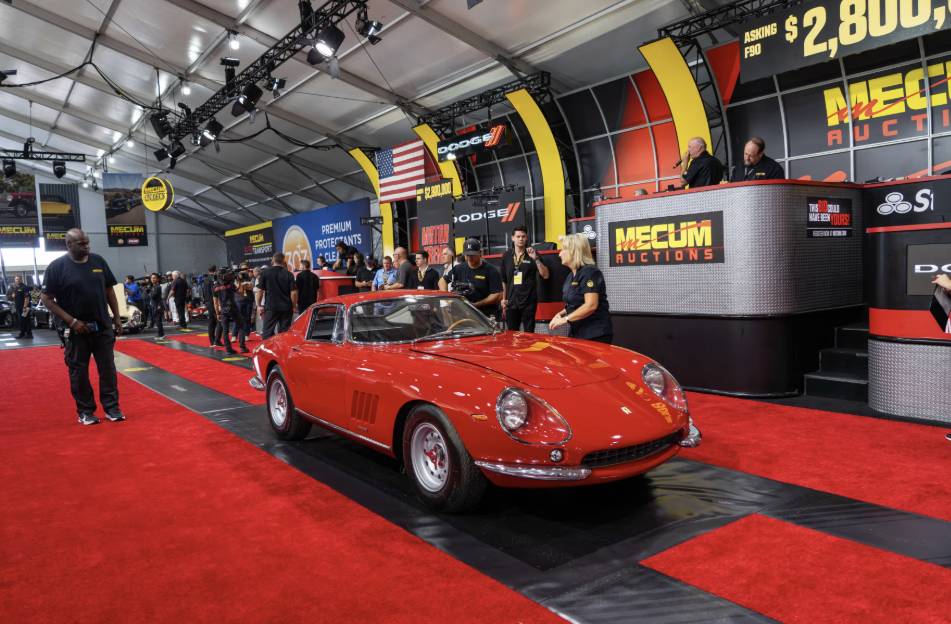
Barrett-Jackson Scottsdale 2026: Are Muscle Cars Still a Smart Investment?
Muscle cars are still a high-conviction alternative investment in 2026, especially for “Condition One” cars with a verified paper trail. While the market has split into two distinct tiers, growth is focused on rare, low-volume models. In these cases, your return on investment is tied directly to the rarity of the parts and the shrinking supply of high-displacement icons.
Barrett-Jackson Scottsdale 2026 is officially scheduled for January 17–25, 2026, at WestWorld of Scottsdale, marking the 55th anniversary of the auction house. The event is projected to feature over 1,900 vehicles, following a 100% sell-through rate in the previous 2025 cycle where the entire car docket was sold at No Reserve. This auction serves as the ultimate real-time valuation benchmark for the collector car market.
With traditional equities fluctuating and macroeconomic uncertainty influencing capital allocation, American muscle has transitioned from enthusiast passion to tangible hard-asset strategy.
As this evolution accelerates, structured car investment platforms such as MCQMarket are increasingly positioning collectible vehicles within alternative asset allocation frameworks focusing on scarcity metrics, documentation integrity, and disciplined entry pricing rather than emotional bidding behavior.
Why is this happening now? As the automotive industry pivots toward electrification, internal combustion engines are becoming mechanical artifacts. This shift introduces a scarcity premium for legacy V8 platforms, which are now viewed as finite production assets. The Scottsdale audience reflects this reality: capital is flowing toward vehicles with supply ceilings and cultural permanence.
Article Overview:
- Why investment-grade muscle cars remain strong alternative assets in 2026
- How Barrett-Jackson Scottsdale 2026 acts as a real-time market benchmark
- Why rarity, documentation, and Condition 1 status now drive returns
- The impact of electrification and macro uncertainty on V8 scarcity premiums
- Key risks: restoration inflation, authentication, and tier-based market divergence
- How MCQ Market aligns muscle cars within a structured alternative investment strategy
2026 Collector Car Market Trends: Macro Environment & Capital Flows
Millennials and Gen X now represent a dominant share of demand for premium muscle platforms like the 1968–1970 Dodge Charger. This demographic shift supports both original-condition vehicles and high-end restomod builds.
In parallel, the infrastructure surrounding the collector car ecosystem is becoming more sophisticated. Barrett-Jackson’s expansion of digital tools and blockchain-backed collectibles signals a broader institutionalization of the segment.
This institutional evolution is mirrored by platforms such as MCQ Market, which approach muscle cars not as speculative purchases but as structured alternative holdings integrating valuation tracking, risk awareness, and portfolio context into acquisition strategy.
Fundamental Validation: Investment-Grade Muscle Cars in 2026
Market value is increasingly being determined through transparent “No Reserve” auctions, with early 2026 data showing stronger bidder engagement and deeper pools for mid-tier muscle cars priced between $75k–$150k. Documentation has become the primary valuation anchor.
Investment-grade muscle cars with documented “1-of-1” or low-production verification via Marti Reports or Galen Govier certifications are demonstrating durable long-term appreciation trends. Historical performance data over fifteen-year cycles supports the resilience of properly validated examples.
The market has clearly segmented into defined categories:
- Heritage Originals: Factory-correct, fully documented cars commanding substantial premiums.
- Top-Tier Restomods: Premium builds from recognized shops exceeding $500,000 USD.
- Drivability Demand: Younger buyers prioritizing performance and reliability, driving velocity in modernized builds.
Muscle cars also maintain a relatively efficient cost-of-carry profile compared to comparable-era European supercars, supporting accessibility within diversified alternative portfolios.
Structured platforms such as MCQMarket often categorize assets to distinguish between preservation-focused vehicles and performance-oriented collectible segments.
Risk/Reward Frontier: What Are the Real Risks of Investing in Muscle Cars?
Strategic acquisition therefore favors vehicles already classified as “Excellent” or above to avoid restoration overhang.
Authentication risk is equally critical. Sophisticated clones of rare trims such as GTO Judges and SS Chevelles require marque-level expertise and independent verification for any acquisition exceeding $100,000.
This due diligence requirement reinforces the value of structured frameworks that prioritize provenance validation and risk mitigation principles increasingly embedded within platforms like MCQMarket.
Conviction Score: High (Blue-Chip Assets) / Moderate (General Market)
Execution strategy in this environment centers on disciplined price discovery at major no-reserve events. Rarity remains the only structural downside protection. Vehicles with verified documentation and cultural weight retain liquidity even during economic contraction.
5-Year Investment Strategy for Muscle Cars (2026–2031 Outlook)
Optimal timeline: Five-year holding period for mid-cycle appreciation, supported by long-term performance data across luxury asset indices.
The structural thesis remains intact: electrification reduces future combustion production, enhancing legacy scarcity.
Capital allocation should focus on:
- High-grade, documented originals
- Limited-production VIN platforms
- Recognized restomod builders with established resale history
Use verified valuation tools and real auction data rather than speculative asking prices.
As the roar of high-displacement V8 platforms transitions from mainstream presence to historical rarity, these machines continue migrating from garages to private collections and institutional-grade alternative portfolios.
Within this environment, structured access models such as MCQMarket may play an increasingly important role in enabling disciplined exposure to the collector vehicle asset class.
Final Verdict: Are Muscle Cars a Smart Investment After Barrett-Jackson Scottsdale 2026?
The strategies discussed in this article can significantly refine how you approach Barrett-Jackson Scottsdale 2026 and muscle car allocation in the current cycle. Effective implementation, however, requires structured evaluation and disciplined entry criteria.
At MCQMarket, we operate as a specialized alternative asset platform offering structured access to classic and collectible vehicle investments designed for enthusiasts and strategic investors seeking exposure to the global collector car market with a portfolio-oriented approach.
Learn more about MCQMarket’s platform and its selection of rare and collectible vehicles.