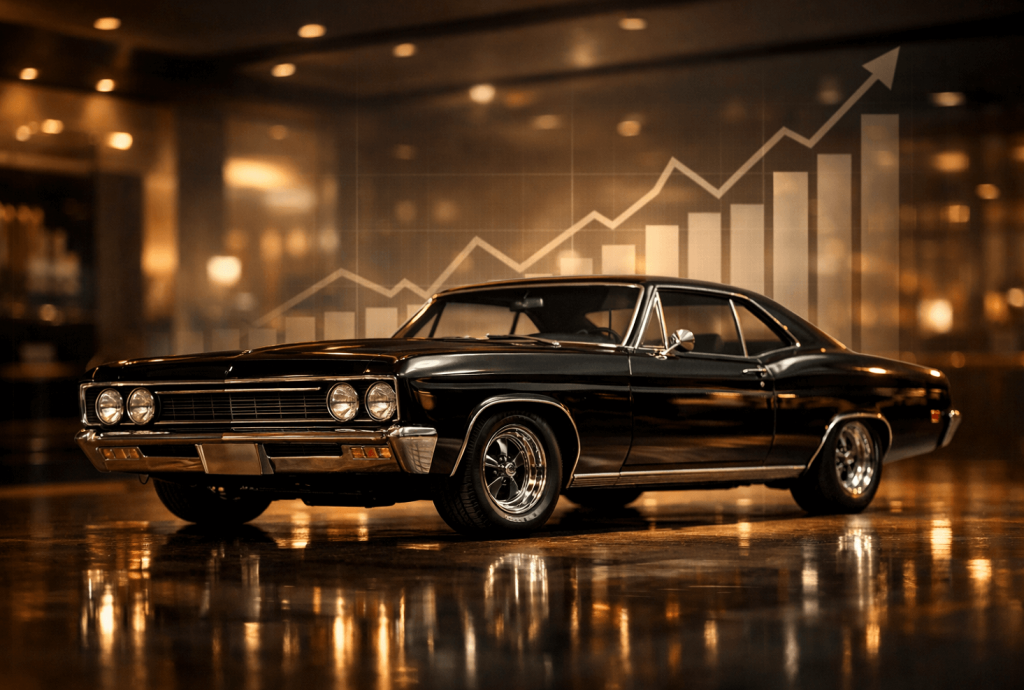
Inflation & Rate Cuts Push Investors Toward Tangible Assets Like Classic Cars
The way capital moves across markets is evolving rapidly. As global economies adjust to persistent inflation and changing interest rate cycles, traditional allocation strategies are increasingly being reassessed. In this environment, some market participants may question whether maintaining significant exposure to cash or low-yield bonds remains effective when inflation continues to pressure purchasing power.
Against this backdrop, tangible assets have drawn greater attention. Among them, classic cars have emerged as a notable segment within the alternative investment space. They combine documented scarcity, historical relevance, and cultural significance, characteristics that differentiate them from purely financial instruments.
Non-yielding assets held outside the traditional banking system are often discussed in macroeconomic terms as potential stores of value during periods of monetary expansion. The growing interest in passion-driven and collectible assets reflects broader diversification trends rather than purely emotional motivations. Physical ownership introduces a different risk and liquidity profile compared to digital or paper-based assets, particularly in environments where liquidity conditions shift rapidly.

Article Overview:
- Inflation and falling interest rates are pushing investors toward tangible assets.
- Classic cars provide scarcity, cultural value, and long-term wealth protection.
- Platforms like MCQMarket make investment-grade cars accessible.
- Highlighted opportunities include the 2014 Mercedes SLS AMG Black Series and 1984 Ferrari 512 BBi.
How Falling Interest Rates are Making Investors Look to Invest in Classic Cars?
Lower yields on savings and bonds push capital toward alternative stores of value. Liquidity increases, credit becomes cheaper, and investors start reallocating funds into scarce, hard assets.
This structural scarcity is visible in investment-grade models currently available on MCQMarket, including:
- The 2014 Mercedes SLS AMG Black Series
- The 1984 Ferrari 512 BBi
Both vehicles represent finite production runs and historically significant engineering precisely the type of assets that benefit from expanding liquidity and inflationary pressure.
Classic Cars in the Global Alternative Investment Landscape
The Rise of “Youngtimers”
Gen X and Millennial investors are actively acquiring performance legends from the late analog era. Limited-production supercars from the early 2000s are increasingly viewed as “modern classics.”
The 2014 Mercedes SLS AMG Black Series stands out here naturally aspirated, aggressively engineered, and produced in limited numbers. Its positioning on MCQMarket reflects how investors are targeting culturally significant, last-of-their-kind vehicles.
Global Demand & Portability
High-end collector cars function as portable wealth. They can be stored securely, insured globally, and transported across borders. This flexibility provides insulation from localized economic or currency instability.
Similarly, the 1984 Ferrari 512 BBi represents an era of mechanical purity and low production volume key ingredients for long-term value preservation in a world of increasing digital abstraction.
Technological Future-Proofing
Concerns about internal combustion bans have softened with developments in synthetic fuels. This has renewed investor confidence in historically important performance cars, particularly those that mark the end of engineering eras.
Understanding the Risk and Reward of Classic Car Investments
Investors must account for:
- Storage and insurance
- Maintenance and specialist servicing
- Illiquidity compared to equities
- Exit timing and market cycles
Unlike stocks, these are operational assets. Returns depend heavily on entry price, condition, rarity, and market timing. Strategic selection is critical.
Conviction Score: High
Despite operational considerations, rare classic cars have historically demonstrated low correlation with public equities. During periods of equity volatility or bond underperformance, finite collector assets often maintain pricing strength due to scarcity-driven demand.
Classic Cars in the Current Macro Environment
The macro backdrop of easing monetary policy combined with persistent inflation creates a favorable environment for tangible assets.
A disciplined strategy includes:
- Targeting limited-production, historically relevant models
- Prioritizing documented provenance and mechanical integrity
- Maintaining a long-term investment horizon
- Leveraging structured platforms for access to institutional-grade vehicles
Platforms like MCQMarket are aligning with this macro shift by offering curated access to high-conviction automotive assets. Opportunities such as the 2014 Mercedes SLS AMG Black Series and the 1984 Ferrari 512 BBi reflect the broader investment thesis: scarcity, engineering pedigree, and global desirability.
Closing Perspective:
Inflation erodes currency. Rate cuts compress yield. Cash slowly loses strength.
But finite, culturally significant assets tell a different story.
As monetary expansion continues and investors seek durability beyond traditional financial instruments, classic cars are emerging as a credible hedge combining tangible ownership with structural scarcity.
Platforms such as MCQMarket are contributing to broader access within the collectible automotive segment by offering structured participation models.
In periods where money supply expands rapidly, assets with fixed or limited supply characteristics are often discussed in macroeconomic analysis as potential long-term stores of value.